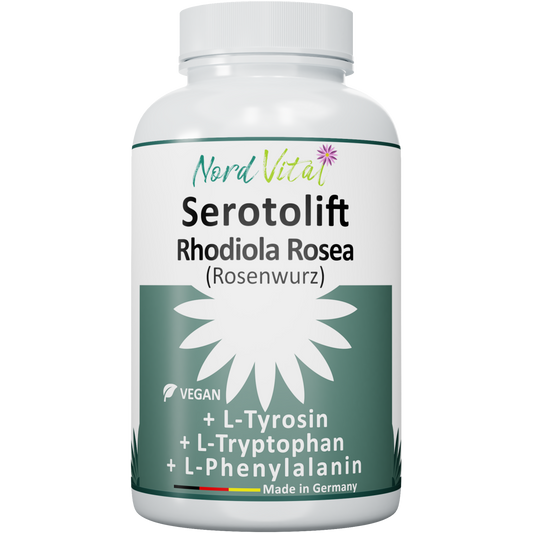
Rhodiola rosea is commonly known as roseroot. Scientific texts and labels may also refer to rosavins, salidroside, root extract, standardisation and the term “adaptogen”. These terms describe different botanical, analytical or historical concepts.
This article explains how these expressions can be distinguished without making a statement about the effect of a particular product.
What kind of plant is Rhodiola rosea?
Rhodiola rosea is a perennial plant in the Crassulaceae family. It grows naturally in cool mountainous and Arctic regions of Europe, Asia and North America.
The underground parts, consisting of the rhizome and root, are the plant materials most often described in scientific and traditional sources.
The genus Rhodiola contains numerous species. An extract from another species is not automatically botanically or chemically equivalent to R. rosea.
What are rosavins?
The term rosavins is generally used for a group of phenylpropanoid glycosides, particularly rosavin, rosarin and rosin. These compounds are used as analytical markers in the characterisation of Rhodiola rosea materials.
A marker helps describe the identity or composition of a plant material. Its presence does not by itself prove a particular effect in humans.
What is salidroside?
Salidroside is a phenolic glycoside found in Rhodiola rosea and in some other plant species. It is also used as an analytical marker.
Because salidroside is not exclusive to R. rosea, botanical identity cannot be established from a single marker alone. Botanical documentation and a broader chemical profile may also be relevant.
What does standardisation mean?
Standardisation means that a plant material or extract is produced or adjusted to meet a defined specification for one or more constituents.
A percentage requires a clear reference basis. It should be evident whether the value refers to one compound, a group of compounds or the total extract.
A standardised value describes a selected analytical characteristic. It does not describe every component of a botanical material.
What does a 3:1 ratio mean?
A ratio such as 3:1 may describe the relationship between the amount of starting plant material and the amount of extract obtained. Its precise meaning depends on the stated extraction convention.
An extract ratio is not the same as the concentration of rosavins or salidroside. It also does not provide complete information about the extraction solvent, manufacturing process or full chemical profile.
Plant powder and extract: what is the difference?
Plant powder is produced by drying and grinding plant material. An extract is obtained by transferring selected soluble constituents into an extraction medium and processing the resulting material.
Powder and extract are therefore not interchangeable descriptions. Different extracts can also vary depending on the starting material, solvent and manufacturing parameters.
What does “adaptogen” mean?
The term “adaptogen” emerged from a historical pharmacological concept. It has been used in different ways and does not identify one specific molecule, analytical marker or uniform regulatory category.
The European Medicines Agency has discussed the concept and its limitations in a scientific reflection paper. The term alone does not establish an authorised health claim for a food or food supplement.
Conclusion
Rhodiola rosea is a defined plant species whose rhizome and root contain various constituents. Rosavins and salidroside are analytical markers, while standardisation and extract ratios describe selected properties of a botanical preparation.
The term “adaptogen” belongs to a broader historical concept and should not be treated as a measurable ingredient or a general health promise.
Frequently asked questions
Are rosavins and salidroside the same substance?
No. They are different compounds and are analysed separately.
Does a 3:1 ratio mean three per cent rosavins?
No. An extract ratio and the percentage of a chemical marker are different specifications.
Is every Rhodiola species equivalent to Rhodiola rosea?
No. Species identity, plant part, origin and processing may influence the chemical profile.
Is “adaptogen” the name of an ingredient?
No. It is a term from a broader historical concept and does not identify a single chemical substance.
Scientific sources
- European Medicines Agency. European Union herbal monograph on Rhodiola rosea.
- European Medicines Agency. Reflection paper on the adaptogenic concept.
- European Commission. EU Register of Health Claims.
Note: This article provides general scientific information, does not refer to a specific product and is not a substitute for medical advice, diagnosis or treatment.